Cushion Center Table: Upholstered Coffee Table Ottomans
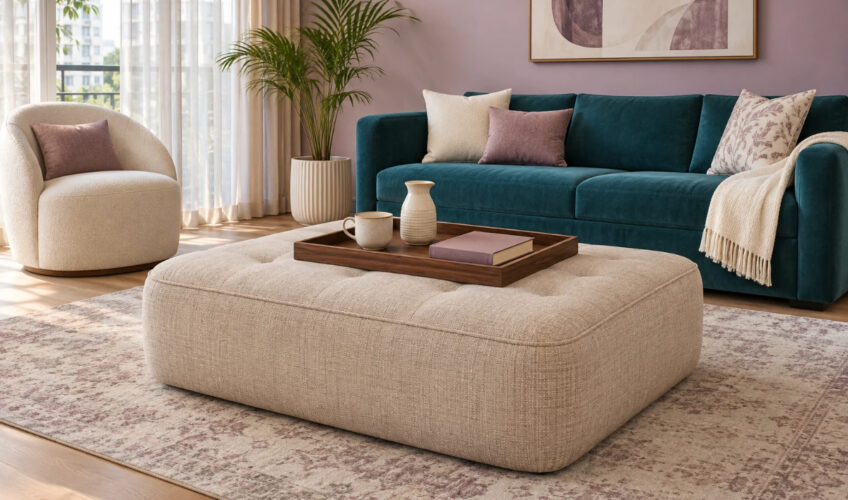
TL;DR: A cushion center table is an upholstered ottoman used in place of a hard-topped coffee table. It is safer around small children, doubles as extra seating and a footrest, and needs a tray to function as a usable surface.
The cushion center table has grown popular in Indian homes for one practical reason: a toddler falling against padded upholstery is a different outcome from a toddler falling against a marble corner.
Beyond safety, it does three jobs where a conventional table does one. Here is what to know before choosing one.
What Is a Cushion Center Table?
It is an upholstered block, usually foam over a timber frame, placed where a coffee table would normally sit.
A cushion center table is safer with toddlers and doubles as seating and a footrest. Tray requirements, fabric choices, sizing rules and storage model checks.
The terminology varies. Retailers describe the same piece as a cushion center table, an ottoman, a pouffe or a padded table depending on size and shape.
The functional definition is consistent: no hard top, no sharp edges, and a surface soft enough to sit on.
Ottoman Coffee Table Versus a Hard Top
The comparison comes down to what you need the centre of the room to do.
- Safety: no corners or edges. The main reason families with toddlers choose one.
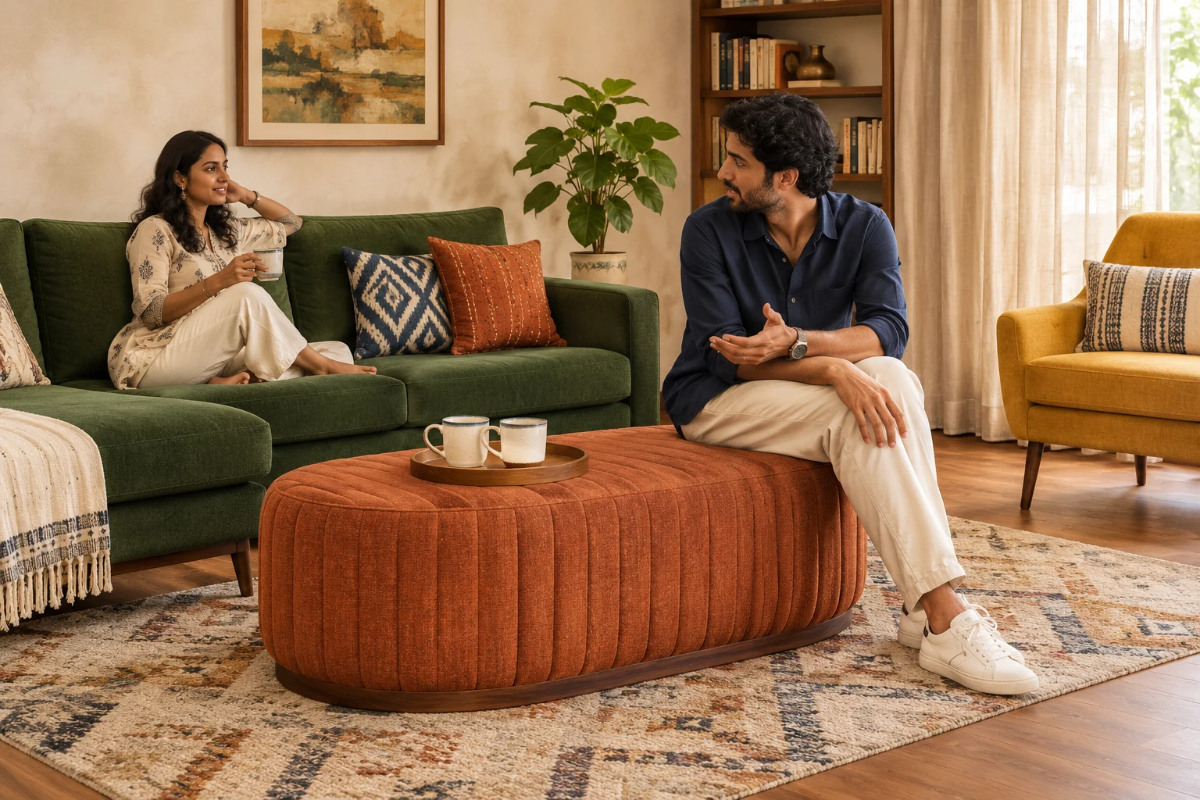
- Seating: an ottoman coffee table adds two informal seats when guests arrive.
- Footrest: the everyday function, and the one most owners use most often.
- Surface: the weakness. Nothing stands on it without a tray.
An ottoman coffee table is the better choice for a family room. A hard-topped table is better where the surface genuinely gets used for work, eating or display.
Making an Upholstered Table Usable as a Surface
A tray is not optional. It is the component that turns an upholstered table into a working one.
Choose a tray at least 45 x 35 cm with a raised lip. Anything smaller tips when a cup is placed near its edge.
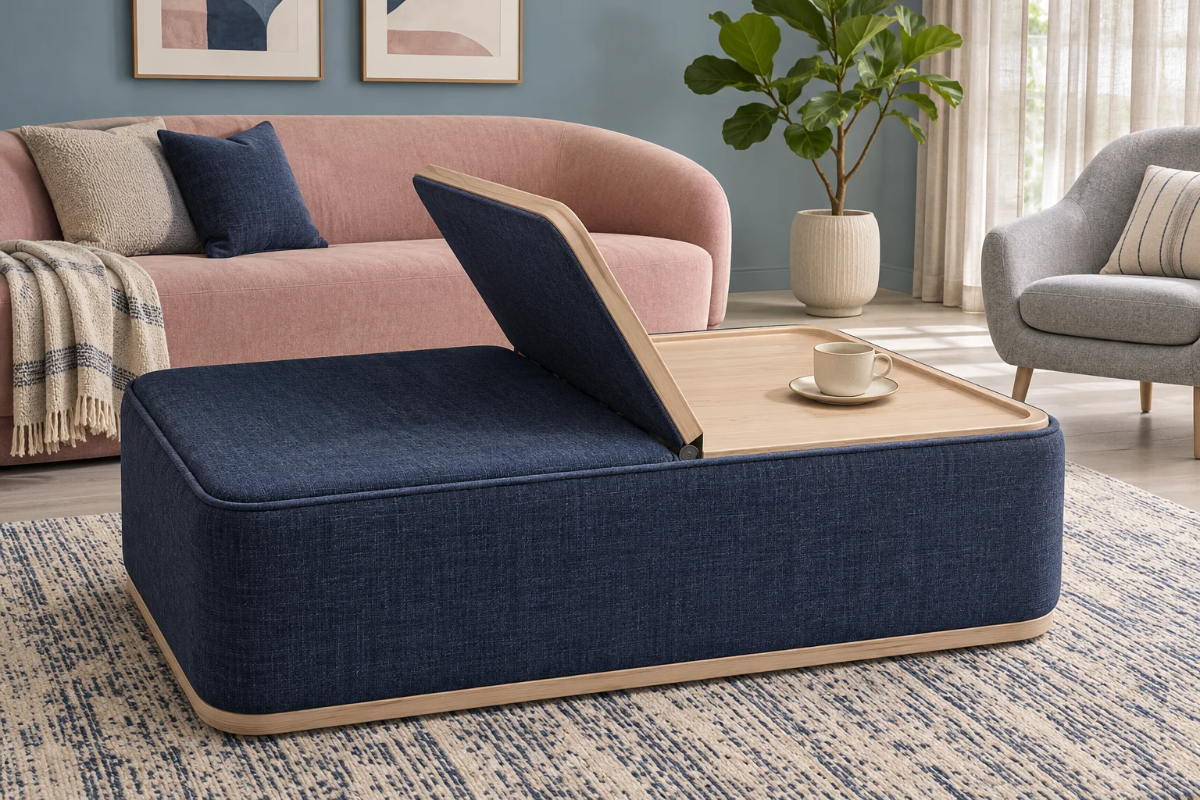
Some upholstered table designs include a flip-top panel, reversible with fabric on one face and a hard surface on the other. These are genuinely practical, though the panel is easy to misplace.
A firm fill matters as much as the tray. Soft fill means the tray sinks and tilts, so specify high-density foam rather than fibre fill.
Is Soft Furniture Practical for Indian Homes?
It depends almost entirely on the fabric specification.
Soft furniture in the centre of a room takes more contact than a sofa does. Feet rest on it, children climb it, and food is passed over it.
Specify a performance weave with a stain treatment, or leather, which wipes clean instantly. Untreated cotton and linen mark within months in this position.
Removable covers change the calculation entirely. Soft furniture with a washable cover in the centre of a family room is practical; the same piece with fixed upholstery is not.
Dark and mid-tone colours are the pragmatic choice. A pale cushion centre table will show every mark in a room that sees daily use.
Sizing a Padded Table Correctly
The proportions follow the same rules as a hard table, with one addition.
- Length: roughly two-thirds the sofa length, as with any centre table.
- Height: level with or slightly below the sofa seat, so it works as a footrest.
- Distance: 40-45 cm from the seat edge, closer than a hard table if used for feet.
- Firmness: firm enough to sit on without collapsing, which rules out very soft fill.
A padded table used primarily as a footrest can sit slightly closer than 40 cm, since nobody needs to walk between it and the sofa.
Storage Versions
Many upholstered centre pieces include internal storage, which is the strongest argument for choosing one in a small flat.
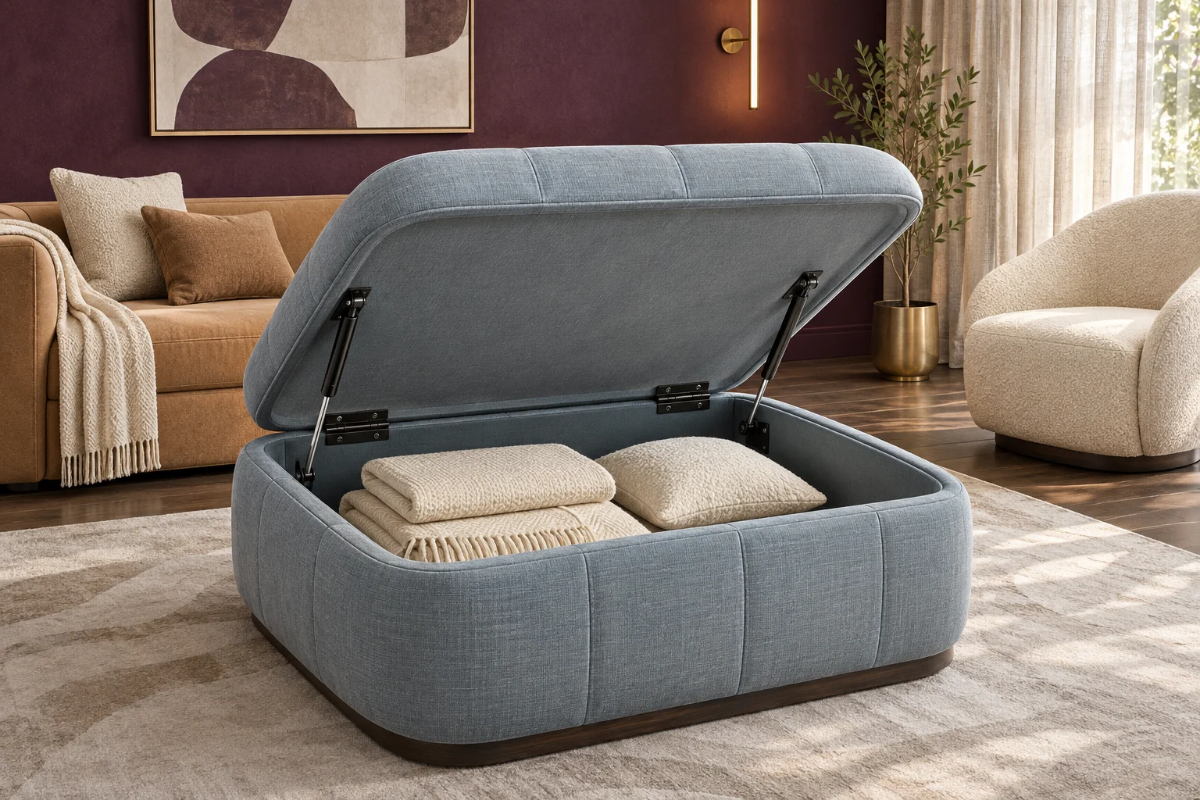
Lift-top models give the largest volume, typically holding blankets, board games or children’s toys.
Check the hinge. A gas strut holds the lid open while you load it, whereas a plain friction hinge drops the padded lid onto your hands.
Verify that the lid is rigid enough to sit on when closed. Some storage models trade structural strength for capacity, and the top flexes under an adult’s weight.
Choosing Between the Two
Buy a cushion center table if you have small children, want extra informal seating, or use a footrest daily.
Buy a hard-topped table if the surface genuinely gets used, or if the room’s centre needs to be a visual statement rather than a soft one.
Compare both in the centre table collection and the relaxing chairs range, or read our guide to centre tables for living rooms. Fabric durability terms are explained under upholstery.

