Guest Room Table: Multi-Purpose Furniture for Guest Bedrooms
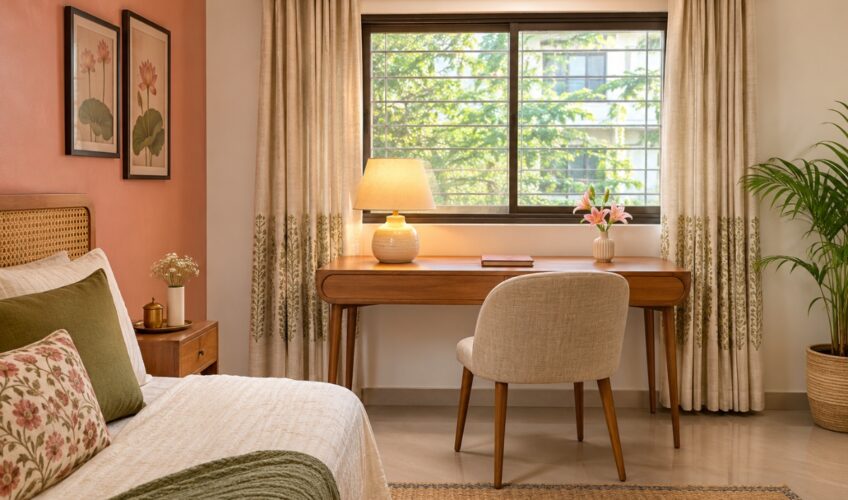
TL;DR: A guest room table has to work for a room used a few nights a year. Choose one surface that serves as luggage stand, desk and bedside table, keep it under 50 cm deep, and avoid furniture that only functions when guests are present.
The guest room table is the piece most Indian homes get wrong, because the room sits empty for eleven months and hosts for one.
Buying for the occupied month produces a room that wastes space all year. Buying for the empty months produces a room guests find uncomfortable. The answer is a surface that does both.
What Should a Guest Room Table Do?
List the jobs honestly before choosing anything. A guest room table typically serves four functions across a single visit.
A guest room table must serve a room used a few nights a year. Sizing rules, best positions, dual-purpose layouts and compact formats for Indian guest bedrooms.
- Luggage surface: somewhere to open a suitcase without putting it on the bed or floor.
- Bedside surface: phone, water, glasses, within reach from the pillow.
- Work surface: a laptop for an hour, not a full working day.
- Storage during vacancy: what the piece holds for the other eleven months.
Very few pieces do all four. The realistic target is a guest room table that handles two properly rather than four badly.
Guest Bedroom Furniture Sizing
Depth is the constraint that matters most, because guest rooms in Indian apartments are usually the smallest bedroom.
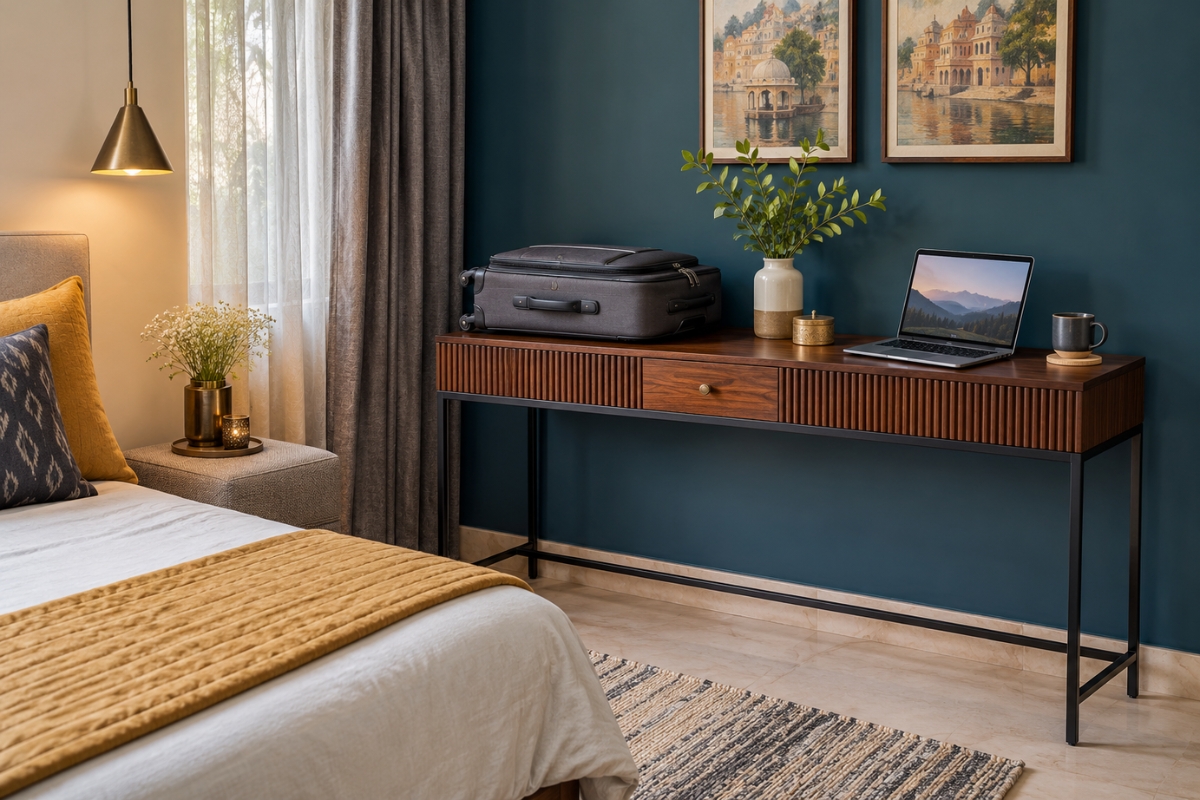
Keep the table under 50 cm deep. Beyond that it intrudes into the walking route between the door and the bed, which is already tight in a 2.7 m room.
Width is more flexible. A 90-110 cm surface takes a suitcase or a laptop comfortably. Below 75 cm, neither fits well.
Height should sit at 72-75 cm if it doubles as a desk, or 55-60 cm if it primarily serves as a bedside surface. Guest bedroom furniture cannot do both heights, so pick the dominant use.
Visitor Room Layouts That Work
Where the table sits changes how usable the room feels far more than what the table is.
- Under the window: the best position. Natural light for working, no obstruction to circulation.
- Foot of the bed: works if the room exceeds 3.2 m in length, otherwise it blocks the route.
- Beside the bed: only if the table is narrow, under 45 cm, or it crowds the sleeping zone.
- Against the wardrobe wall: avoid, since it blocks the wardrobe doors when a chair is pulled out.
A visitor room also needs a chair that does not live in the room permanently. A folding or stacking chair stored elsewhere keeps the floor clear during the empty months.
Spare Room Furniture for Rooms That Do Two Jobs
Most guest rooms are not only guest rooms. They are home offices, study rooms, store rooms or ironing rooms for most of the year.
Spare room furniture should therefore be chosen for the dominant use and adapted for the occasional one. If the room is a home office for eleven months, buy a desk and add a bedside surface when guests arrive.
That inversion saves both money and space. A proper desk with a small folding side table beats a compromised piece that serves neither use well.
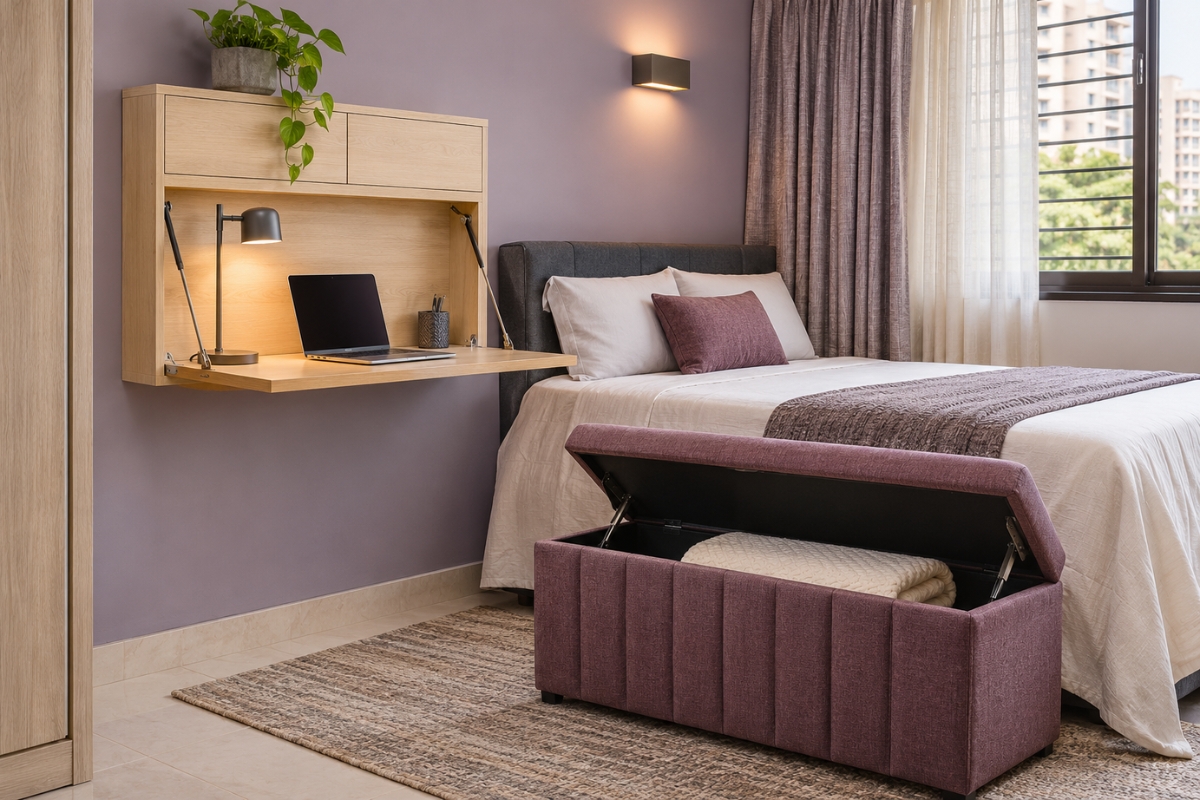
Where the room is genuinely dual-purpose, wall-mounted spare room furniture is worth considering, since a folding wall desk occupies zero floor area when closed.
Compact Tables Worth Considering
Four formats suit guest rooms particularly well, each solving a different constraint.
- Console table: 30-40 cm deep, takes a laptop, works against a wall without intruding.
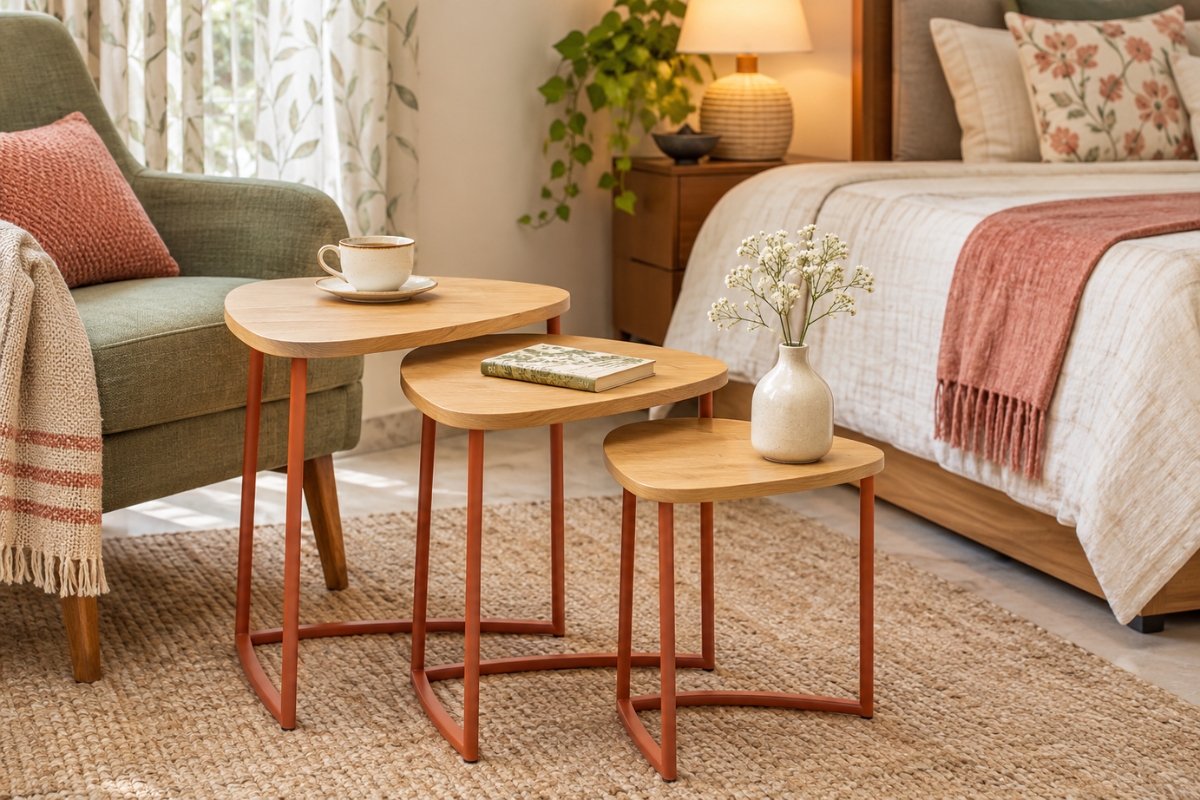
- Nesting set: two or three compact tables that separate for guests and stack when empty.
- Folding wall desk: zero footprint closed, full surface open. Best for genuinely small rooms.
- Bench with storage: luggage stand during visits, blanket storage the rest of the year.
Nesting compact tables are the most flexible of the four, because the count of usable surfaces scales with the number of people in the room.
Materials and Finish
Guest rooms see irregular use, which creates a specific problem: dust settles for weeks between cleans.
Matte finishes hide dust far better than high gloss. Textured wood and powder-coated metal both outperform lacquer in a room cleaned monthly rather than daily.
Avoid glass tops in a guest room entirely. Glass shows every fingerprint and every week of settled dust, and it will look neglected the moment a guest walks in.
Choose a surface that tolerates a suitcase being dragged across it. Soft timber marks permanently; laminate and sealed hardwood do not.
Bringing the Room Together
Buy the table for the eleven empty months, then add one small piece for the occupied ones.
Browse compact surfaces in the coffee and side table range and the living room furniture collection, or read our space saving furniture guide.
Wider context on how these rooms are used is covered under the guest room entry.